

- NDVI ranked as the second most important predictor of runoff variability after precipitation.
- NDVI-mediated pathways increasingly reinforced precipitation effects and offset negative temperature effects.
- Natural runoff shifted from widespread decline before 2000 to spatially heterogeneous recovery after 2000.
Zhang, X., Zheng, H., He, H., Lu, J., Wu, S., Cheng, D., Fan, Y., Lou, Y., Delang, C. O., & Gomez, C. (2026). Ecological restoration reorganizes climate–runoff pathways in the Yellow River Basin. Ecological Indicators, 189, 115203. https://doi.org/10.1016/j.ecolind.2026.115203
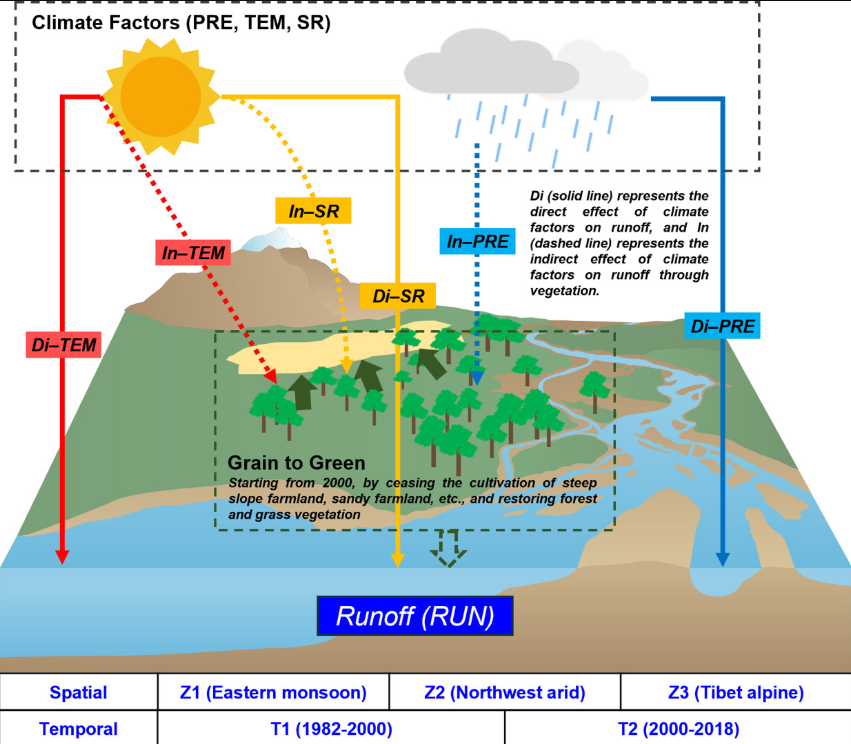
Abstract
Vegetation restoration is reshaping dryland river basins, yet its hydrological consequences remain uncertain because greening can both enhance land-surface water retention and increase biological water consumption. This uncertainty is particularly relevant for the Yellow River Basin, where large-scale ecological restoration has coincided with marked changes in climate and runoff. Here we examine naturalized runoff, climate variability and vegetation greenness across the basin from 1982 to 2018 to determine whether post-restoration greening was associated with altered climate–runoff relationships. Natural runoff changed from a broad decline during 1982–2000 to a post-2000 recovery, although the recovery was not spatially uniform. Precipitation remained the primary positive predictor of runoff, while NDVI emerged as the most important secondary predictor. Temperature and solar radiation showed weaker and generally negative associations. Statistical pathway decomposition further indicated that vegetation greenness modified how climatic signals were associated with runoff. The area where NDVI-mediated pathways reinforced precipitation effects increased from 54.19% to 61.47%, and the area where they partly offset negative temperature associations increased from 33.41% to 47.83%. These results suggest that vegetation recovery did not produce a uniform hydrological response, but was linked to a reorganization of climate–vegetation–runoff associations. Restoration assessments in dryland basins should therefore consider not only vegetation gains, but also how greening changes runoff sensitivity to climate.