

About this book
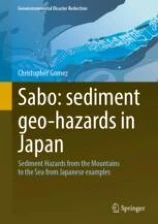
Because science has grown in specialized silos, multi-hazards and hazards that cross spaces and scales remain under-represented in the academic literature. Recent books on the sediment cascade have begun to address this, yet they remain organized around particular sets of processes, and the boundaries of academic specialty still bound their approaches. This book takes a different route, through a body of concepts developed in Japan: SABO, which encompasses sediment hazards from the mountain tops to the coast. Although SABO first emerged in Western Europe, it was in Japan that the concept reached maturity, and for decades it has driven sediment disaster risk prevention and management there, shaping both scientific and engineering practice. Such a holistic approach is particularly pertinent in the face of climate change, since sediment production and hydrological cycles are already shifting in ways we still grasp poorly. The author offers a window into this Japanese approach to science, setting out the key concepts and governing equations that shape it, supported by a rich set of figures, maps and photographs, and including original research. The book is intended for graduate students in the geosciences and engineering, as well as for professionals working in the field.
Bibliographic information
- Book titleSabo: sediment geo-hazards in Japan
- Book subtitleSediment Hazards from the Mountains to the Sea from Japanese examples
- AuthorsChristopher Gomez
- Series titleGeoenvironmental Disaster Reduction
- PublisherSpringer Cham
- Copyright informationThe Editor(s) (if applicable) and The Author(s), under exclusive license to Springer Nature Switzerland AG 2027
- Hardcover ISBN978-3-032-42508-9Due: 08 December 2026
- Softcover ISBN978-3-032-42511-9Due: 08 December 2027
- eBook ISBN978-3-032-42509-6Due: 08 December 2026
- Series ISSN2946-5710
- Series E-ISSN2946-5729
- Edition number1
- Number of pagesXVIII, 301
- Number of illustrations20 b/w illustrations, 166 illustrations in colour