
Huazhu Zheng, Yongjiao Wu, Jungang Lu, Dong Cheng, Xun Zhang, Zhengyu Yao, Claudio O. Delang, Christopher Gomez, Hongming He. 2026. Assessing Grain Production Eco-Efficiency under Rural Land Management Institutions: A Hybrid Analytical Framework, Socio-Economic Planning Sciences, 102433,
https://doi.org/10.1016/j.seps.2026.102433.
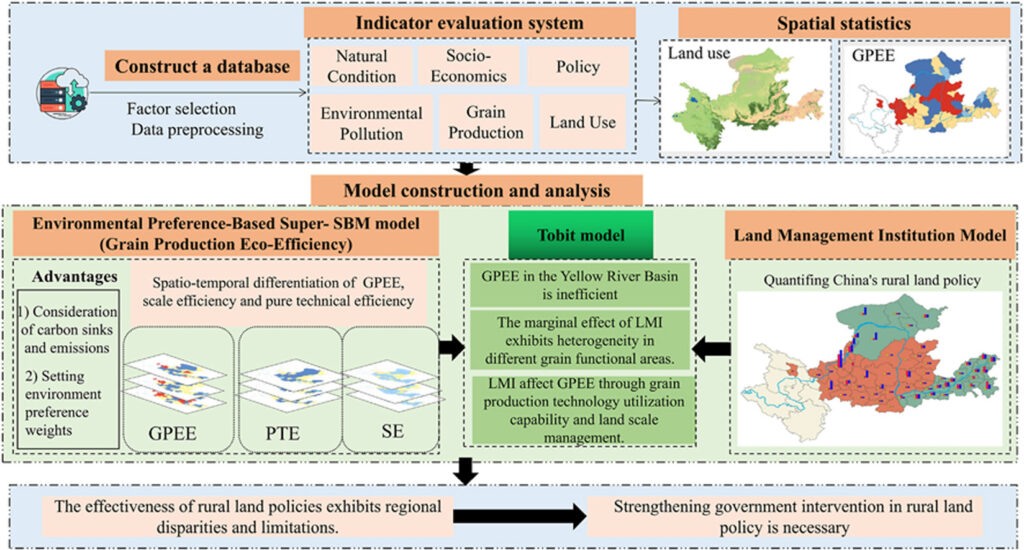
Abstract: This study evaluates grain production eco-efficiency (GPEE) and constructs a Rural Land Management Institution (LMI) index to quantify rural land policies in China and examine their impacts on GPEE in the Yellow River Basin (YRB). A hybrid analytical framework integrating an environmental preference-based Super-SBM model, Tobit regression, and mediation analysis is applied to socio-economic and ecological data from 53 cities in the YRB during 2000–2021. The main findings are as follows: (1) GPEE in the YRB was generally inefficient and remained below the national average throughout the study period. (2) Significant spatial and temporal heterogeneity is observed in GPEE, pure technical efficiency, and scale efficiency, with positive spatial autocorrelation characterized by high-high (H-H) and low-low (L-L) clustering patterns. (3) Pure technical efficiency contributes more to overall GPEE than scale efficiency, which remains relatively weak. (4) Changes in arable land are strongly influenced by rural land policies, with pronounced regional heterogeneity in LMI across different areas. (5) Rural land policies affect GPEE through two main channels: grain production technology utilization capability and land scale management. (6) In balanced grain production and consumption areas (BGPCA), LMI significantly improves both pure technical efficiency and scale efficiency, thereby enhancing GPEE, whereas in major grain-producing areas (MGPA), the effect of LMI on GPEE is limited, indicating environmentally unsustainable production practices. These findings highlight the need for more targeted and region-specific policy interventions by the central government to promote sustainable improvements in grain production eco-efficiency.
Keywords: Grain Production Eco-Efficiency; China’s rural land policy; Rural Land Management Institution Model; the Yellow River Basin