






Large wood and driftwood flowing in rivers have a positive role for the ecosystem, but this benefit is often trumped by the hazard it represents to lives and infrastructures, especially in areas with stepp channels (like Japan).
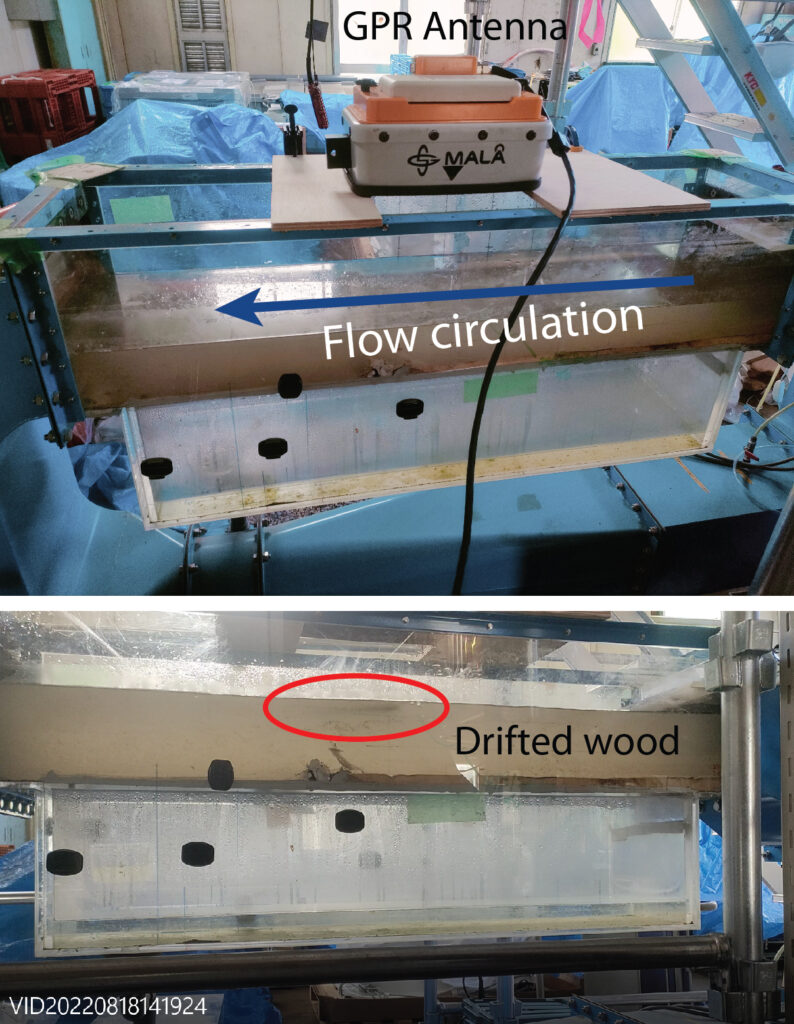
If post-event mapping, detection and numerical simulation have made important progress, it is still impossible to detect the wood-debris as they travel, due to poor visibility conditions (rain, night…), the present project, financed by the Japanese Kakenhi, has been tested a novel method based on radar pulses and the variation of the return signal, to differentiate water flow from water flow with drift wood (Fig. 1 on the left shows the lab. experiments).
BACKGROUND: Large wood found both within river channels and embedded in riverbeds (Fig. 2) has been shown to fulfill a critical geomorphic function in natural ecosystems [1], creating a tension between ecological and economic objectives. Throughout history, industrialized nations systematically removed logjams from major waterways, given their potential to exacerbate flood events and interfere with river-based economic activities [2]. Wood debris further serves as an indicator of recruitment dynamics within a river catchment, particularly through its depositional configurations (e.g., isolated large or small pieces, individual or clustered jams…) [3]. Stream size and location also govern the balance between wood deposition and transport: mountain streams tend to mobilize wood debris primarily during flood events [4,5,6], whereas larger rivers are capable of transporting such material even under moderate flow conditions [5]. The characterization and volumetric assessment of wood debris across floodplains and waterways typically takes place following transport and settling events. This is carried out for wood accumulating in reservoirs upstream of dams using removal volume records from hydroelectric operators [7], as well as through historical and time-lapse imaging [7], geometric estimations derived from field photographs of deposits [8], and digitization of post-flood accumulations [9]. Even within field research, the study of wood debris “dynamics” remains predominantly focused on deposited material [10], with entrainment [11] and mobility data [12] being drawn exclusively from laboratory experiments and numerical simulations. This highlights a notable gap in both scientific understanding and hazard monitoring: the absence of systems capable of tracking wood in active transport within rivers, operating reliably during intense rainfall and nighttime conditions.
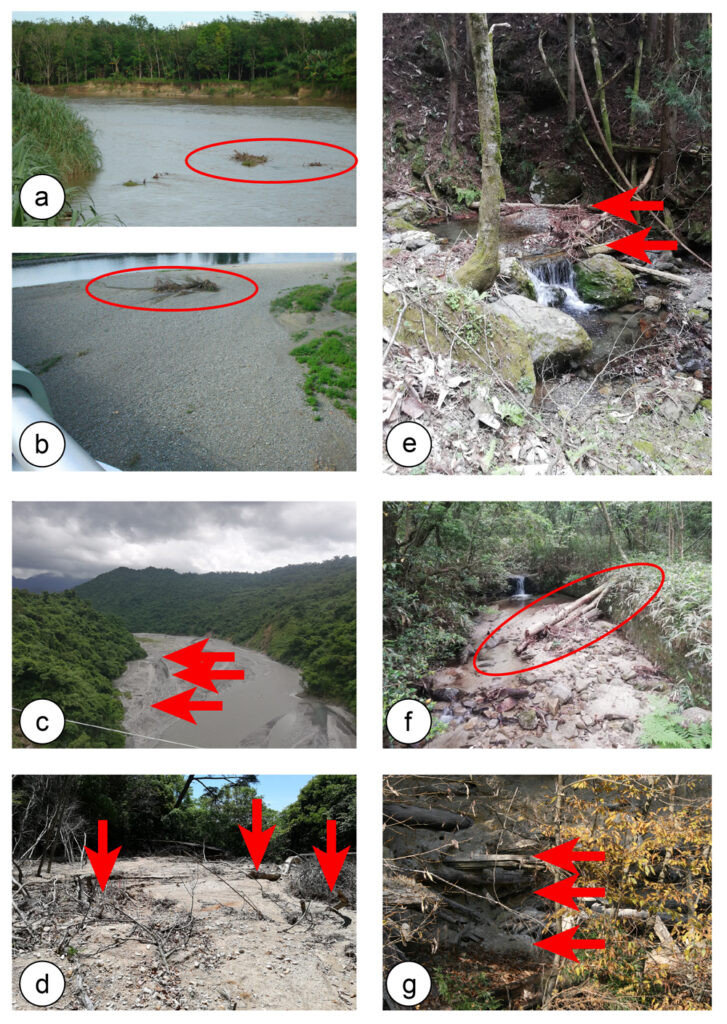
Fig. 2 Examples of large wood transported in various rivers in Taiwan, on Sumatra Island, on New Zealand South Island and in Kobe (Japan).
WOOD DETECTION RESULTS WITH RADAR:
The radar has proven an effective method to detect wood travelling downtream a flow, simulated in a flume with the radar 25 cm above water level and using a commercial 800 MhZ antenna on a time-stack (Fig. 3).
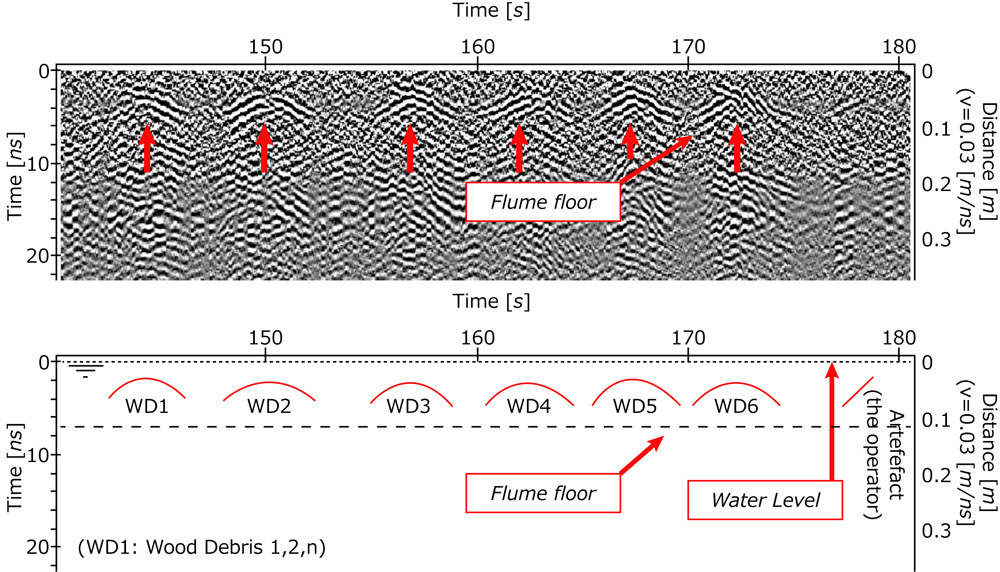
Fig. 3 Example of wood log detection experiments (0.5 cm diameter) in a controlled environment.