

As part of her PhD research, Dr. Nomura wrote: “Ecological risk of diethylhexyl phthalate (DEHP) and non-phthalate plasticizers in Osaka Bay – Japan and in rivers of Central Java -Indonesia”, and her work has been accepted Journal of Hazardous Materials Advances (IF: 9.34).
Miho Nomura, Djati Mardiatno, Bachtiar W. Mutaqin, Andhika Puspito Nugroho, Aditya Saputra, Christopher Gomez. 2026. Ecological risk of diethylhexyl phthalate (DEHP) and non-phthalate plasticizers in Osaka Bay – Japan and in rivers of Central Java -Indonesia. Journal of Hazardous Materials Advances
A B S T R A C T
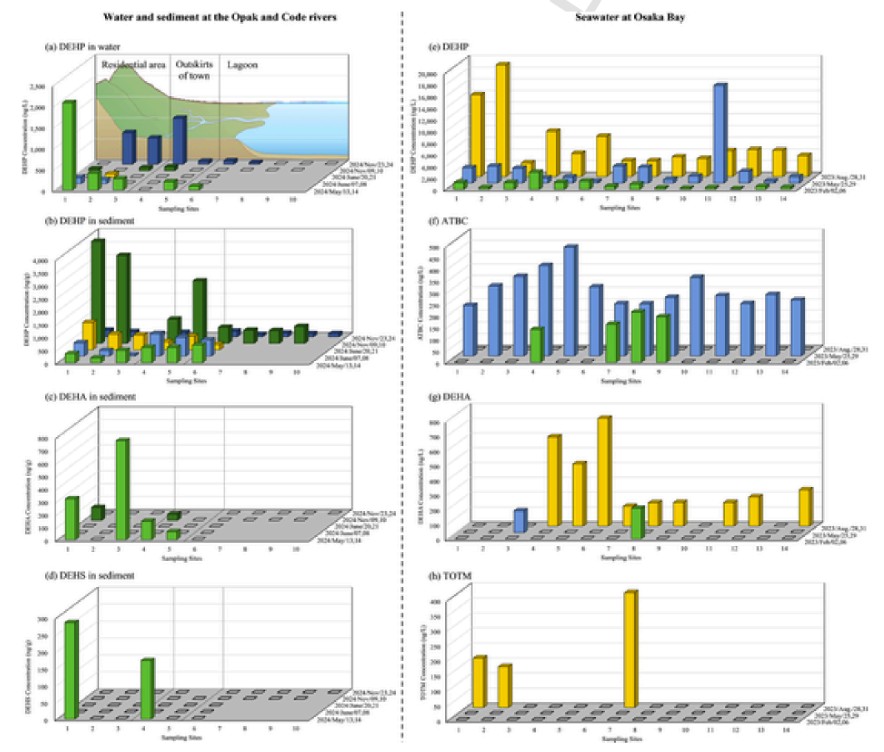
Non-phthalate plasticizers (NPPs) are increasingly used as alternative plasticizers without any clear understanding of the associated ecological risk. Therfore, this study aims to evaluate those for diethylhexyl phthalate (DEHP) and NPPs (diisobutyl adipate (DIBA), acetyl tributyl citrate (ATBC), di-(2-ethylhexyl) adipate (DEHA), di-(2-ethylhexyl) sebacate (DEHS) and trioctyl trimellitate (TOTM)) in Osaka Bay, Japan and in the Opak and Code rivers (Indonesia). Risks were assessed using a risk quotient (RQ), by comparing the residual concentration with the predicted no-effect concentration (PNEC). PNECs were derived from toxicity values on fresh/marine water organisms. Residual concentrations were quantified in seawater from Osaka Bay, and in freshwater and sediment from the Indonesian rivers. This provides the first toxicity data for NPPs on marine organisms, with macroalgae being the most sensitive. There were no-observed-effect concentration (NOEC) of 0.5 mg/L for DIBA and 1.0 mg/L for DEHA, DEHS, and TOTM. Within NPPs, only ATBC showed toxic for worms (NOEC: 60mg/kg). In Indonesian river sediment, relatively high concentrations of DEHA and DEHS (241 and 229 ng/g, respectively) were observed, suggesting temporary contamination. Recorded NPPs concentration in Indonesian river water were lower than those in Osaka Bay. The high values of Osaka Bay are arguably due to small factories’ wastewaters. DEHA and TOTM presented low ecological risks (RQ<0.7 and RQ<0.04) in Osaka Bay, but this may increase as NPPs demand is rising. To our knowledge, this study is the first to assess the ecological risks of severalNPPs, and provides new PNECs and ecotoxicity data relevant for future risk assessments.